CASE STUDY
CONCEPT 1 – BANDOLIER BAG
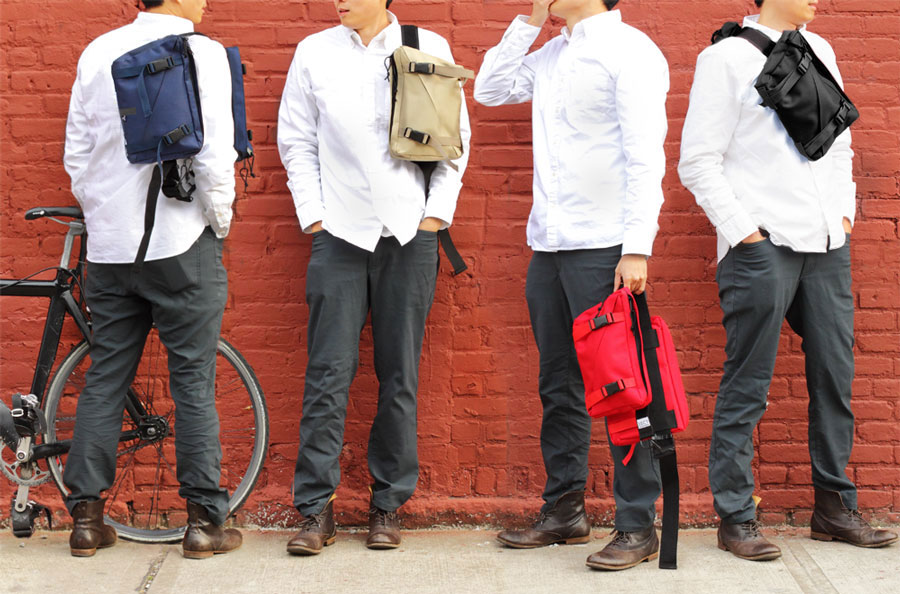
INTRODUCTION
As a cyclist I wanted a bag that sat between a messenger bag and a lumbar bag, which didn’t exist in the marketplace. The messenger bag was too big for light days but was great for accessing items without removing the bag and/or stopping/getting off the bike, while the lumbar bag was too small and awkwardly placed. Additionally, I noticed people wearing lumbar/hip bags across their chest, which were not balanced for that position.
CHALLENGES
– Where to get it made?
– What materials to use?
– Where to source components?
– What is the cost to produce and at what quantities?
– What is the correct price point and how do I achieve that?
– How do I get people to buy it?
– How do I establish a unique brand/product that could stand out in the marketplace?
PROTOTYPE/DEVELOPMENT
First I did a series of sketches of how I might want it to look and sit. Then I made paper mock ups to figure out the proper size and scale relative to the body. I also theorized what a person might carry in it and what its limits were – an iPad, a light jacket, a book, and a beverage was ideal, but not a laptop. Finally, I sewed a very rough prototype myself as a proof of concept to test balance and fit.


It was of paramount importance to make the bag functional, but also be visually and functionally unique as well as solve use problems. I intentionally created the bag with two pouches because 1) there was no bag on the market like this with two pouches, 2) it was better balanced, 3) I had neither the influence nor the scale to compete on price so the two pouches on one bag allowed for more capacity and thus a higher price point without much additional cost. Additionally, distinctive features include folding the pouches in half to be smaller, a pleat for expansion, and each pouch is removable.
In assessing the production cost and ultimately the retail price, I had to simplify the construction, number of parts, labor, and initially do only one color – black. One could always add more features more with feedback. It is better to make it more affordable than over design it thus creating an inaccessible price.
PRODUCTION
I met with many factories and sample makers and intentionally chose a local one in order to understand the process better and maintain quality control, while being able to make small quantities of 100 pieces despite the labor cost being much higher. I researched and sourced the final off-the-shelf materials and hardware for the bag via the internet. I decided on a heavier poly duck fabric that gave the bag structure and made the diagonal pleat functional. Once the sample was finalized I used the same sample maker to do the production run due to his familiarity with the process.
The small 100 piece runs allowed me to be more nimble, agile, and financially conservative in case the bag flopped, had flaws, or if alterations were needed. It allowed me to test the bag as well as the audience.
BRANDING/WEBSITE
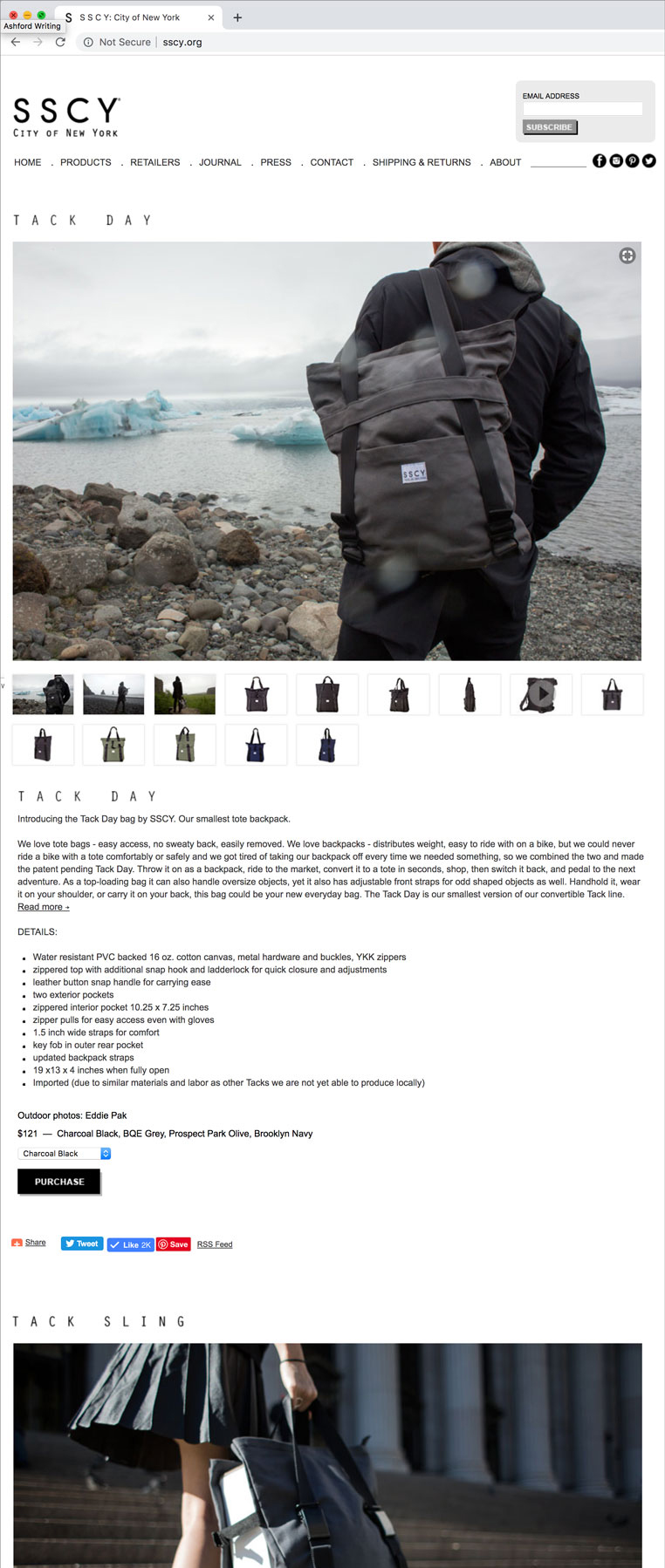
I realized the key aspect of branding and the website would be to educate the consumer in order to make a sale. Once I had the product, I needed a website for people to learn about the product and then purchase it. I also had to create a brand, a logo, and an image to sell the product. Most importantly, though, I had to tell a story of how it could be used and why one would need it. Knowing a single photo on a website would not be clear enough to sell the product, I intentionally chose more of a blog format over the common ecommerce grid format. The customer needed to see the bag more holistically, not only as a lifestyle product, but also its functionality embedded in a narrative in both image and text. I shot photos that felt elevated in order to not only justify its price, but also relay a sense of quality, desirability, intelligence, good design, and a sense of style and adventure. I, then, wrote succinct copy that detailed not only the features/selling points, but also noted use case scenarios in a friendly, fun, and adventurous tone.
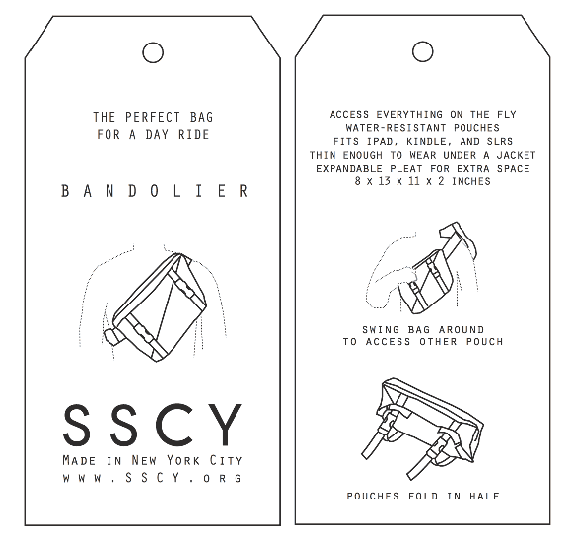
Additionally, looking at the bag on a shelf its unique qualities and use were not obvious, so an informative and instructive hangtag was attached to the bag.
PROMOTION
Making a product and website, however, is not enough to sell bags. How would people hear of the bag? Through various connections I was able to get press in various online and print publications including Marie Claire Italy, Hypebeast.com, Coolhunting.com. View press at www.sscy.org/press
RESULTS
Over 300 pieces sold since inception.
CONCEPT 2 – CONVERTIBLE TOTE/BACKPACK BAG AND VARIATIONS:
INTRODUCTION
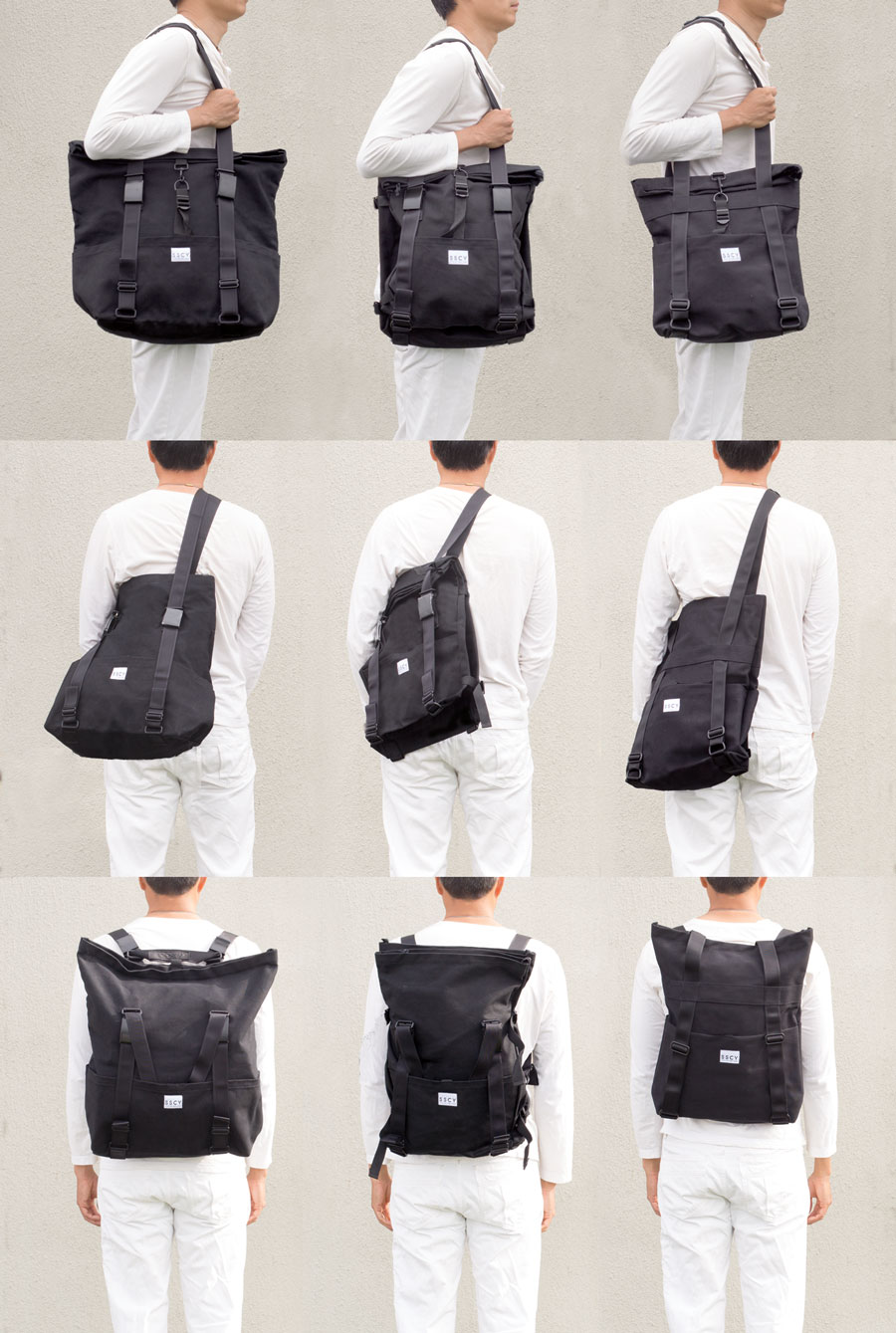
As an avid bike rider I saw people either awkwardly wearing their tote bags as backpacks despite it not being designed for that use or biking dangerously unbalanced with a tote hanging on their handlebars. Although, backpacks are great at weight distribution, they are troublesome to get something in and out quickly and easily. Tote bags, on the other hand, provide easy access, look great, and keep one’s back cool, but are problematic while cycling. I decided to combine the two.
PROTOTYPE/DEVELOPMENT/PRODUCTION
Like the first bag, the Bandolier, I needed to use a consistent design language and followed a similar process of sketching, prototyping, development, and production.


CHALLENGES
After the launch of the first large version, customers requested a medium version and then a small version. For the medium version, I had to add a new feature/design element as the labor and materials of the medium would be very similar to the large, but could not demand the same price; thus I added an open center sling in the middle for awkward or oversized objects to fit in the middle. With this added functionality, I could at least keep the price and consequently the profit margin comparable to the large version of the bag.
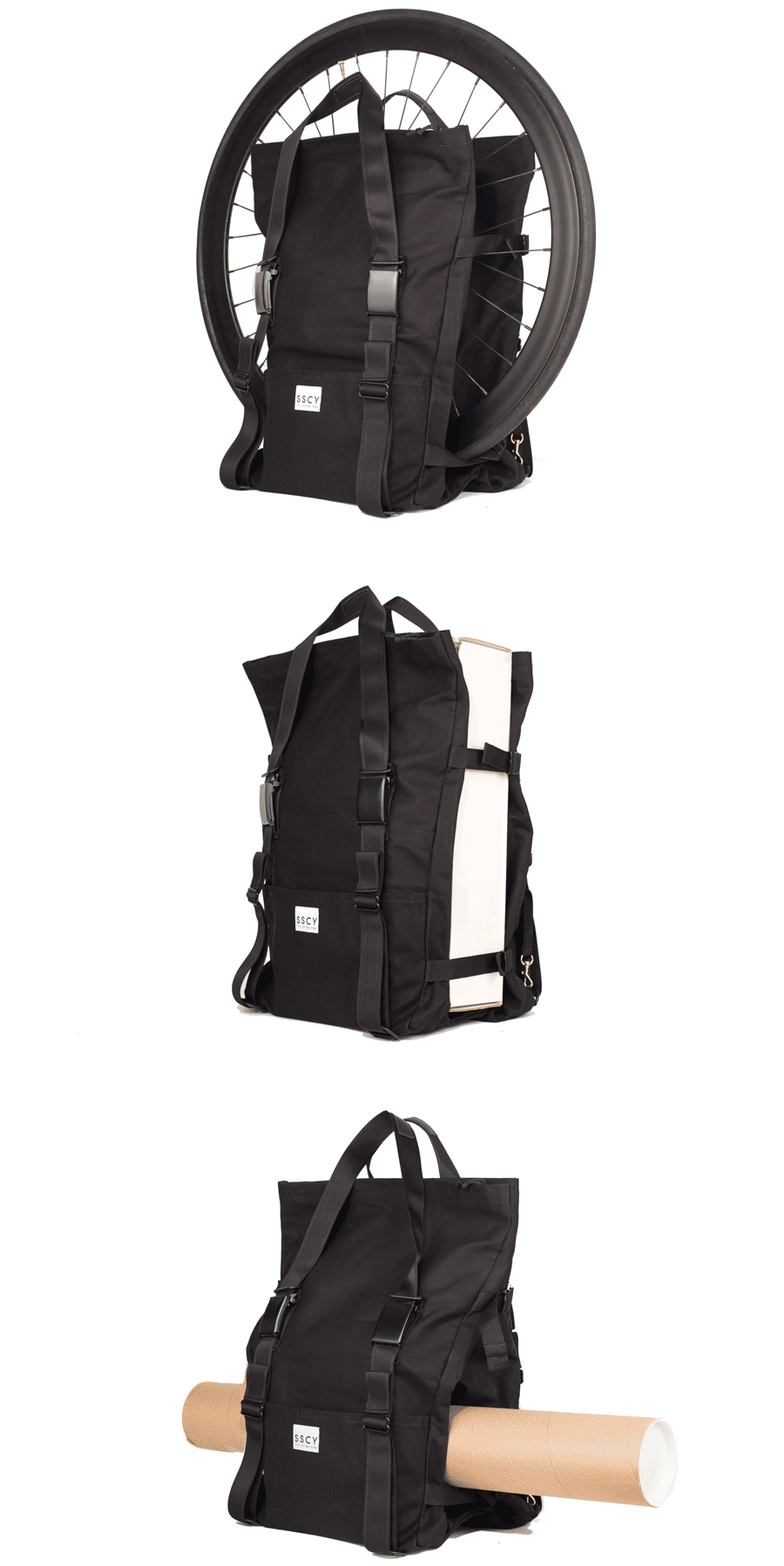
The small version had the same cost issue as the medium, which forced it to be made overseas due to cheaper labor costs.
MARKETING
As I started to sell at trade shows and fairs, I needed a postcard for customers to take that displayed the product (as opposed to merely a logo or otherwise) as a clear reminder for possible sales later.


Hangtags were made for the bags in order to educate the consumer on the unique features of the bag, which would not be obvious at first glance.
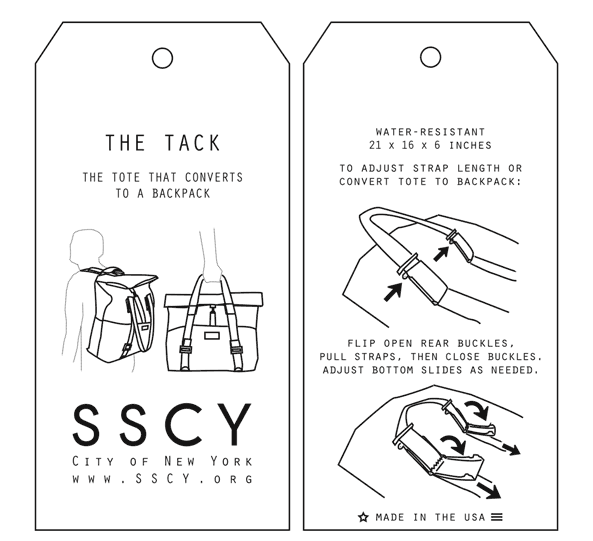
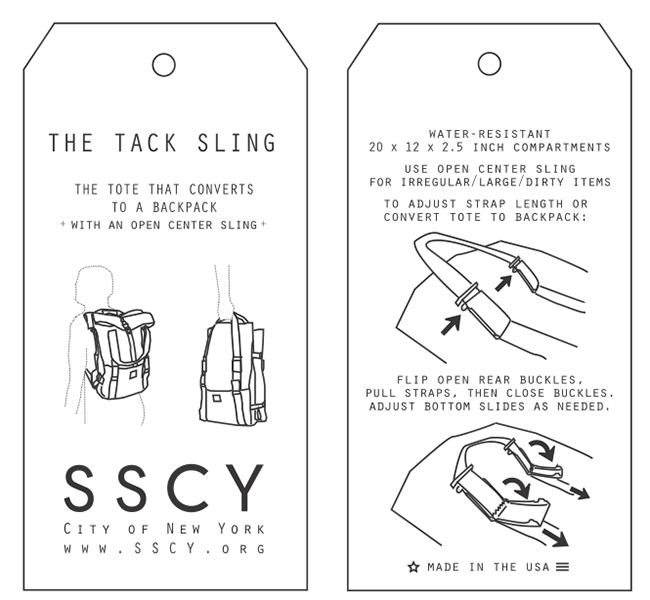
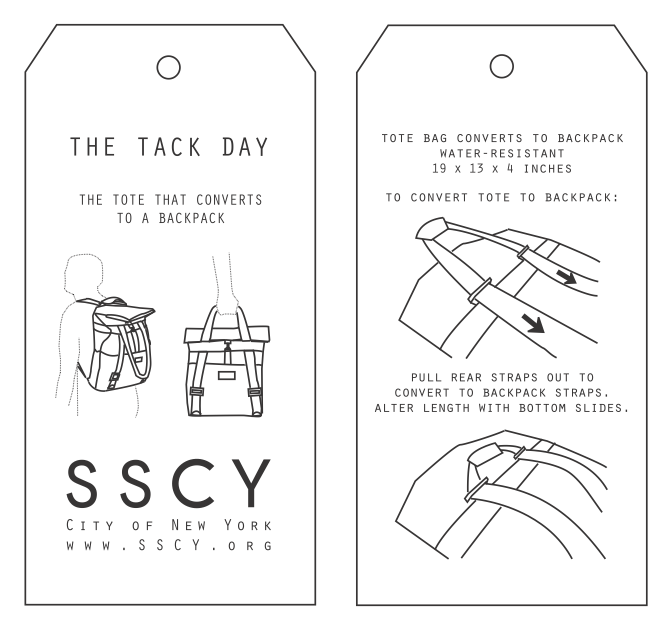
I conceived, shot, directed, and edited a social media video ad to highlight the unique feature of how quickly and easily the bag converts from a tote to a messenger to a backpack.
RESULTS
SSCY has sold nearly 3000 pieces to generate $300,000 in sales since inception.